Moss Landing Health Issues - Part 2
- Jeff Jorgenson

- Dec 7, 2025
- 10 min read
Updated: Dec 8, 2025
Part 2 starts with the May 20th Board of Supervisors meeting (video here, our MCR report here). For me that meeting raised more questions than it gave answers.
Many residents voiced their concerns about PG&E’s desire to re-open their side of Moss Landing (still on hold after a failed attempt) in context of the insufficiency of communications and response as well the adverse health effects caused by the BESS300 fire.
As Erin Brockovich said, ”Accidents happen first and then they have to get the science, so they may not know right now. They are doing the testing to find out for themselves what the hell happened and it comes too late. So you need to become your best advocate.”
Supervisor Church is obviously frustrated (3:40):

“We have had four or five incidents over the last five years, I’ve heard promises, I’ve heard guarantees that this can’t happen, that can’t happen but unfortunately they happen and those promises, those guarantees ring a little bit hollow to me. Because we have a bad track record out here and that I think is why when this Jan 16th fire took place we sent a letter, the county, on Jan 22nd out asking both Vistra and PG&E to not re-open until the cause of the fire was determined. Now PG&E’s argument here that you are a separate facility you have a wall separating you but you’re now down because you had a fire next door. What happens next door does impact you.”
3:44: “You’re here in this community, you’re here in this county, you got to take that extra step with both these entities having what I am just going to call a poor track record the last few years. Again, our request, that letter it feels that its been ignored in many ways. Communication hasn’t come back until the last minute. It hasn’t gone to the community. We don’t have an emergency response plan that’s adequate at this time and it’s not satisfying, it’s not comforting, and I just don’t know where to go from here actually. Because we just had the biggest battery fire in the world take place just a few months ago and I don’t see anything really changing on the story on how the communications going about and how anything can be worked together or how things can be made safer or how things can be cleaned up.”
Monterey Count Supervisor Kate Daniels captured the vibe of the meeting well when she spoke of feeling like like guinea pigs.

3:46: “One of things I think it is important to note. That we do feel in Monterey County like the guinea pigs, we feel like we are the ones who had to experience the worst battery fire that’s ever been had. And we then have been engaging in this process to figure out what that means and how that impacts our home environment, our health, our well being, spaces in this county that we cherish because its some of the most beautiful landscapes that we have.”
3:48: “Everyone in this room stood at the edge of the Moss Landing facility and watched that fireball for more than 24 hours. Then had it reignite and we weren’t ready. We didn’t have air monitoring at the time that we needed. We didn’t have in place what we needed to understand what was happening.”
3:49: “Until we can feel ready - We were the guinea pigs on that side (the fire) to be the guinea pigs for going back on line. We need to be sensitive to when the appropriate time is for that. I think what we’re hearing in this room today is that we need the questions that we asked and the requirements that we made in our letter to be fulfilled before we go back online.”
To me there is still a very big piece missing.
With PG&E announcing they are delaying their reintegration of their half of Moss Landing until next July, it seems to me there is an opportunity to develop and put in place a comprehensive plan to mitigate community concerns regarding battery safety, communications, air quality monitoring and inter-organization emergency response.
I sent an email asking Monterey Director - Department of Emergency Management Kelsey Scanlon if a Post-Mortem had been done.
While I was at UCSF and the SF Department of Public Health events like this always triggered an incident post mortem.
It is a blameless process that aims to analyze what went wrong, understand the root causes of the disaster, and implement preventative measures to avoid similar events in the future. It's a crucial process for learning, improving, and enhancing future disaster response and resilience. You generally try and have them soon after the event while details are fresh.
Was a post mortem on the response performed?
If so, what were the conclusions drawn?
What was determined to have worked and what needs to be improved?
Who led the postmortem?
Will the results be made public?
I am awaiting a response.
For incident commander North County Fire Chief Joel Mendoza who’s underfunded team was on point during the response I want to ask:
Do you feel your fire fighters were adequately trained for this event?
Did they have the right equipment?

Would having your own Air Quality monitoring via drones be advantageous to you if there was a similar incident?
For Public Health Orgs of Monterey and Santa Cruz counties:
Corinne Hyland, spokesperson for the Santa Cruz County Health Services Agency
Dr. Edward Moreno, the Monterey County Health Officer
What steps, if any, has your organization taken since the Moss Landing fire to be better prepared for next time?
More of my questions:
I would also like to know: Where is the County report from the toxicologist?
At the May 20th meeting The PG&E reps repeatedly were not aware of other organizations that they should be engaging with. Is there a list of agencies that should have been involved or involved earlier been identified?
From the Survey it was clear that communications could be better:
What is the plan to improve Communications?
Who is responsible for this item?
Animal plan - Monterey has one but residents complained they were not informed of what to do with their livestock and pets - what happened? Wasn’t it activated?
And the big one: Who is on the hook for answering these questions and ensuring any issues are fixed?
With all these open questions, here are some recent activities that are very relevant to the communities’ concerns.

9/16 The County Board of Supervisors meeting (2:40 to 4:36) received two reports regarding the contaminants and clean up of Moss300.
The first came from Nicki Fowler, Supervisor for Environmental Health Review Services who reported on the sampling and testing activities in the community. These can be reviewed on the county’s dashboard. These include soil, air and water.

Next up was the US EPA. They presented a slide deck. They explained they are only responsible for everything that is happening inside of the walls of Moss Landing - which is substantial. They have multiple websites including the Moss Landing Vistra Battery Fire Response page and an FAQ page that contains information regarding the EPA’s role, air monitoring, soil sampling and a list of the contaminants that they are measuring.
They also have a Moss Landing Community Involvement Plan.
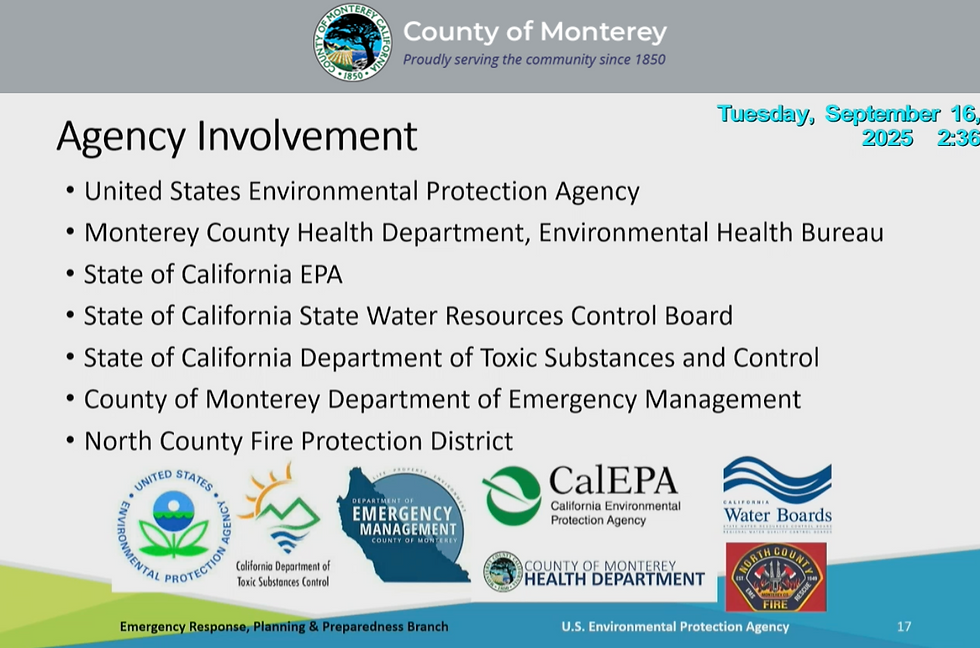
Here are the current players involved in the clean up:
After the presentations there was a public comment period. I saw and heard a lot of familiar faces. Mostly people directly affected by the fire and its aftermath (health symptoms, pets, businesses). All very earnest about their experiences and all looking to the Supervisors for leadership.
To their credit during the final comment section the Supervisors took time to address many of the issues raised (often in these types of meeting there are general statements and the committee moves on the next order of business).
Supervisors Daniels and Askew wanted to understand all the materials they should be worried about since multiple member of the public expressed concern and skepticism on the EPA testing and kept insisting the Dr Aeillo’s (San Jose State) findings were different than the current reports. The EPA again said all of that is on our website and it is.
Supervisor Daniels also wanted to know who will hold the operators at Moss Landing accountable moving forward…and this is the rub. The EPA says it’s not them.

Supervisor Church explained that the county is not the one providing the permit to operate that is the CPUC (its actually the CEC). AB205 CEC allow utilities to bypass the county.. “At the county level we walk a really delicate line.”
“That doesn’t mean we don’t have the right to stick a rule in here. We do. One way we do that is from the public. The public being able to speak out, and making a voice out of that, is one of the most powerful things that there really is!”

9/20 Never again Moss Landing (NAML) - Wanted answers and after the September 16th Board if Supervisors meeting posted that the EPA did not provide them. Yet we have seen that the EPA and Monterey County both have provided sampling and testing info on easily accessible public websites. So why is NAML asking for more?
Katie Singer answers that question here in her article for NAML. Locals collected samples and sent them to ALS Labs. In parallel as we noted Dr. Aiello of San Jose State also collected samples and sent them to California’s Department of Toxic Substances Control (aka DTSC). Singer claims both sets of samples showed much more contamination than the EPA and the County have reported.
Singer says, “aerosolized hydrogen fluoride is lighter than air—and therefore almost impossible to find with ground instruments. EPA also looked for particulate matter of 2.5 microns and higher—but these sizes are larger than the vaporized emissions. After the BESS’s metals and chemicals exploded into skies above the facility and vaporized, the mist that formed traveled sideways, cooled off and descended onto surfaces of land and water—which NAML and Dr. Aiello sampled."
The EPA website FAQs:
Q: What air monitoring technology did you use?
A: To monitor particulate matter, we used TSI DustTrak Monitors. We used the Honeywell SPM Flex (with the mineral acid chemistry cassette) to monitor for hydrogen fluoride.
The TSI website shows that the TSI DusTrak Monitor referenced actually measures “size-segregated mass fraction concentrations corresponding to PM1, PM2.5, respirable, PM10 and PM Total size fractions”. What’s the real story? Mission City Research will follow-up. Stay tuned.

The TSI website shows that the TSI DusTrak Monitor referenced actually measures “size-segregated mass fraction concentrations corresponding to PM1, PM2.5, respirable, PM10 and PM Total size fractions”. What’s the real story? Mission City Research will follow-up. Stay tuned.

Update: (12/1) While we were getting ready to publish, Dr. Aiello penned his own article: When the world’s largest battery power plant caught fire, toxic metals rained down – wetlands captured the fallout. Here’s why his word carries so much weight with the locals: “I am a marine geologist who has been tracking soil changes in marshes adjacent to the Vistra facility for over a decade as part of a wetland-restoration project.”
Most alarmingly he says: “We estimate that about 25 metric tons (55,000 pounds) of heavy metals were deposited across roughly half a square mile (1.2 square kilometers) of wetland around Elkorn Slough, and that was only part of the area that saw fallout.”
He believes “At Moss Landing, some of the government’s sampling turned up low concentrations of the metals, likely because the samples came from broad, mixed layers that diluted the concentration of metals rather than the thin surface deposits where contaminants settled.”
To his credit he also mentions the newer generations of batteries specifically those that use “iron phosphate cathodes are also considered safer from fire risk.“
He also says his team will keep monitoring. We will too.

At a 10/8 CASI meeting (which I attended) local citizens again expressed:
Their unhappiness that the fire occurred
Vistra’s response
The current actions of their local leaders
Their concern for their fishing and wildlife ecosystems
Apprehension with how the EPA is overseeing the clean up of the site. They are far from impressed.
And at the same time showing their support for a safer clean energy source that would prevent a repeat of the Moss Landing fire and its toxic aftermath. It was a lively discussion handled ably by host David Hurwitz, with many people vehemently disagreeing with the presentation.

10/10 Governor Gavin Newsom has signed Senate Bill 283. Written by State Senator John Laird - Under SB283 battery storage developers will be required to meet with the local fire authority at least 30 days prior to submitting an application for a new project. This consultation must cover key safety aspects, including facility design, risk assessments, and emergency response planning…In addition, developers will be required to arrange and pay for a post-installation inspection of the facility by the local fire authority before the system is allowed to begin operation.”
Senate Bill 283 will go into effect on January 1, 2026. This is a good thing however given many of the rural locations of these projects local fire authorities may or may not be adequately funded and/or equipped to tackle these massive facilities. The CPUC and Facility Owners should be on the hook for providing the resources needed for the locals to provide public safety
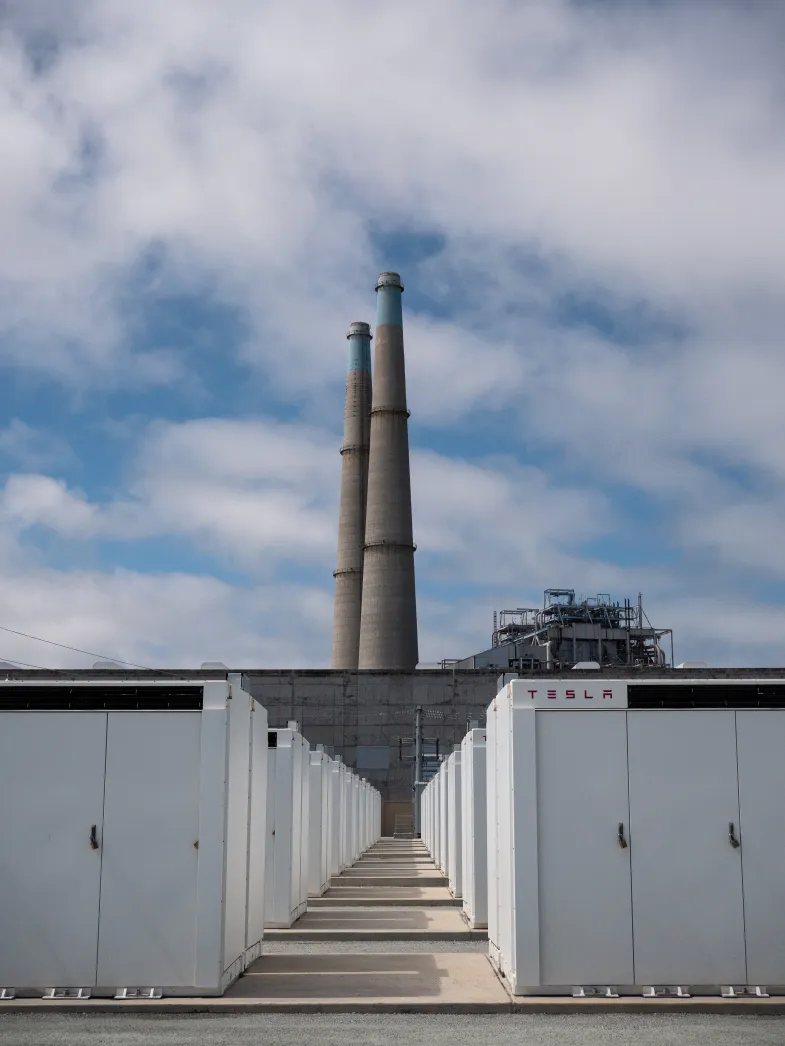
10/24 After listening to Supervisor’s Glenn Church apparent frustration with…well almost everything on this topic its no surprise he is proposing a temporary moratorium on new battery energy storage projects in Monterey County. Good for him. Here’s the crux: “I’ve talked to counties up and down the state — Orange, San Diego, Los Angeles — supervisors who have been developing local ordinances because there aren’t many out there,” Church said. “The problem is that for larger facilities, those 200 megawatts or more, the state can completely bypass the county.”
“I want us to be able to deal with the smaller facilities we already have, like the one in Parkfield (in South County) that caught fire about a month ago” (8/30/25 Solar Farm Fire prompts evacuations.)
“Two other counties have done this, Solano County and Orange County,” Church said. “They’ve had moratoriums in effect for some months, and they haven’t been challenged. What a moratorium does is allow you to have this in place while you’re developing an ordinance.”
Draws a line in the sand:
“One thing I’m going to bring up is that we should not allow, under any condition, any more indoor battery facilities to operate,” Church said. “We’ve seen how dangerous they can be.”
“The county has requested that both of them not reopen until a cause is determined. PG&E wasn’t involved in the fire, but they had a lot of soot and ash on their batteries. They had to clean them, and now they have a cooling problem, so they probably won’t open up until June of next year,” Church said.

Addendum 1: 11/21 - Santa Cruz County supervisors are fine tuning guidelines for battery storage facilities in an effort to keep control over a proposed development near Watsonville.