When assessing the status of coal, we consider two key factors: the amount of electricity generated from coal and the remaining capacity of coal power plants. Generation at current coal plants declines as new sources of generation come online: solar, wind, geothermal, natural gas, and nuclear. Capacity declines when coal plants retire.

Coal generation has experienced a dramatic decline in the Western US since 2010 and will drop even further over the next decade. We expect coal generation to drop below 50 TWh in the Western US by 2030 and there is a possibility of the closure of all major coal plants by 2035.
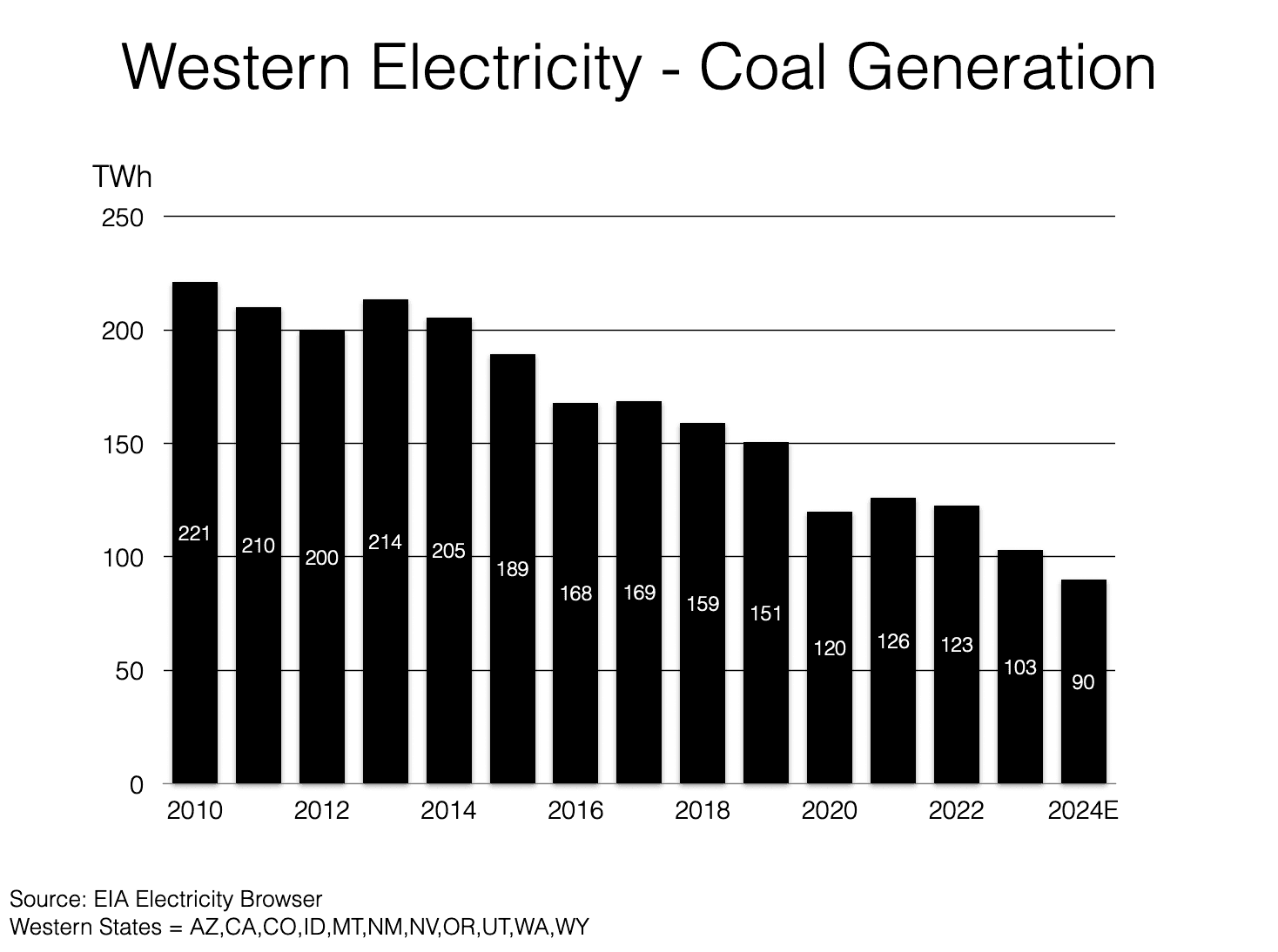
Note: the estimated generation total for 2024 is based on data seen through August.
At the end of 2013, the Western US had about 32,200 MW of coal capacity. Since then, approximately one-third — or 10,000 MW — of coal plants have retired.
This leaves a total remaining coal capacity for the Western United States at the start of 2024 at 21,991 MW — spread across nine states, with Idaho and Oregon being coal-free.
In the first half of 2024, two units at the Jim Bridger plant in Wyoming — the 531 MW Unit 1 and the 539 MW Unit 2 — were converted to gas. Subtracting these two units leaves the October 2024 Western coal capacity at 20,921 MW.
Here is a breakdown of the remaining capacity per state:
| State | Coal Capacity |
|---|---|
| WY | 6,069 |
| UT | 4,581 |
| CO | 3,804 |
| AZ | 2,943 |
| MT | 1,630 |
| NM | 1,540 |
| NV | 740 |
| WA | 670 |
| CA | 57 |
| ID | 0 |
| OR | 0 |
Looking forward we can see how planned retirements will affect the remaining amount of coal capacity.
| Year | Start Cap (MW) | Capacity Retired | End Cap (MW) | Units Retiring |
|---|---|---|---|---|
| 2024 | 21,991 | 1,070 | 20,921 | WY - Jim Bridger 1,2 - convert to NG |
| 2025 | 20,921 | 4,716 | 16,205 | AZ-Cholla 1,2 CO-Comanche 2 CO-Craig 1 NV-Valmy 1,2 NV-TS Power 1 UT-InterMountain 1,2 WA-Centralia 2 WY-Naughton 1,2 |
| 2026 | 16,205 | 562 | 15,643 | CA- Argus 1 CO Pawnee convert to NG |
| 2027 | 15,643 | 1,027 | 14,616 | CO-Hayden 2, WY-Dave Johnston 1,2,3,4 |
| 2028 | 14,616 | 970 | 13,646 | AZ Springerville1 CO-Hayden 1 CO-Craig 2 |
| 2029 | 13,646 | 936 | 12,710 | CO-Craig 3 CO-Nixon 1 CO-Rawhide 1 |
| 2030 | 12,710 | 0 | 12,710 | |
| 2031 | 12,710 | 2,290 | 10,420 | NM-FourCorners 1,2 Comanche 3 |
| 2032 | 10,420 | 1,168 | 9,252 | AZ- Coronado 1,2 Springerville 2 |
| 2033 | 9,252 | 0 | 9,252 |
Over the next nine years, an additional 12,700 MW of coal capacity will retire. This represents about 58% of the 2024 capacity. It is worth noting that this figure does not include any unannounced retirements, which would further reduce coal capacity over the next decade.
New sources of generation like solar, natural gas, wind, geothermal and nuclear will continue to eat into coal’s share of Western generation. This will happen even if demand increases as expected due to electrification and the building of more data centers. By 2030 we think Western coal generation could drop below 50 TWh.
Stay tuned for more articles in this series.
This article is part of the Mission City Research series on the Western Grid in the United States. Mission City Research is a nonprofit based in Monterey, California, and one of its goals is to help build a cleaner Western Grid.